
FPGA Vision, Sensor and Edge AI Solutions for High-Performance Applications by LogicTronix
Holoscan Sensor Bridge (HSB) Enablement with AMD-Xilinx FPGA
LogicTronix provides comprehensive Holoscan Sensor Bridge (HSB) enablement for AMD-Xilinx FPGA platforms, enabling seamless integration with NVIDIA Holoscan ecosystems for real-time sensor fusion and AI-driven applications.
- As a critical pipeline for next-generation vision systems, HSB ensures efficient data flow between sensors and compute units. In addition, LogicTronix enhances FPGA pipelines across Lattice, Microchip, and Altera platforms, delivering optimized performance and flexibility for diverse edge AI and embedded vision deployments.
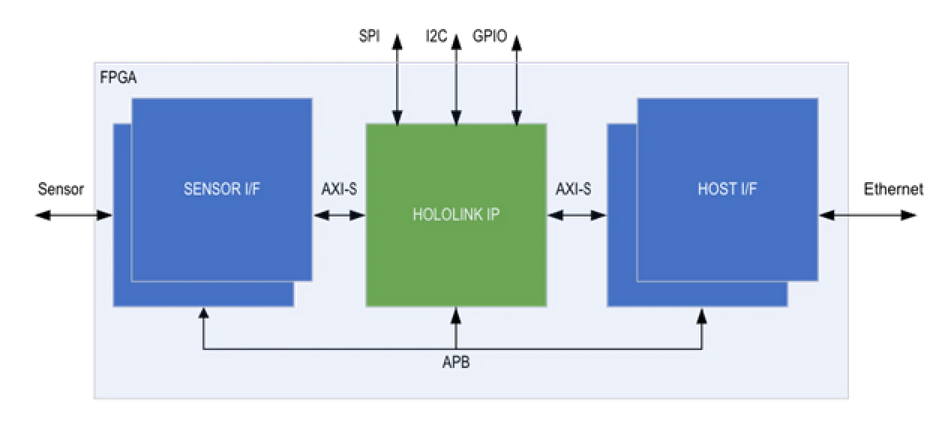
Figure – Holoscan Sensor Bridge IP in FPGA [Source – NVIDIA]
High-Speed Frame Grabber Solutions with AMD FPGA
LogicTronix offers high-speed, high-resolution Frame Grabber IP cores and complete pipeline solutions built on AMD-Xilinx FPGAs. These solutions are designed to handle large volumes of image data with low latency, making them ideal for applications such as machine vision, medical imaging, and high-speed inspection systems. With optimized memory handling and interface support, our frame grabber solutions ensure reliable and efficient image acquisition.
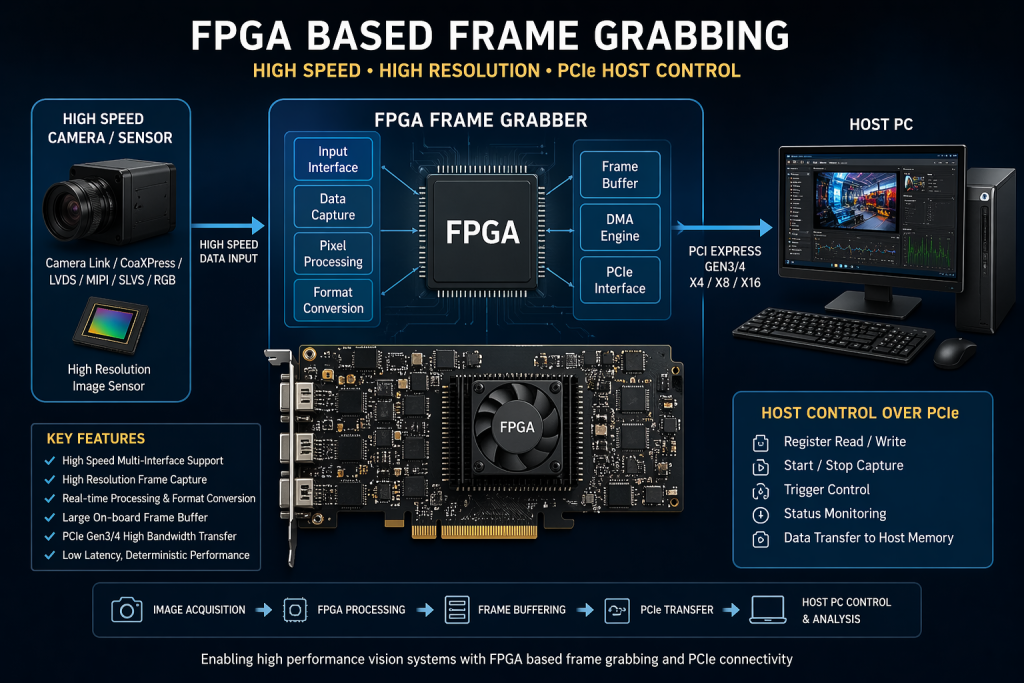
Figure – High speed frame grabber system based on AMD Ultrascale+ or MPSoC FPGA
GigE Vision Solutions for Industrial Applications
GigE Vision is a widely adopted interface standard for industrial and manufacturing environments, and LogicTronix delivers robust, high-performance GigE Vision solutions tailored for such use cases. Our offerings include high-speed frame grabbing and sensor data acquisition pipelines that ensure stable, long-distance transmission with minimal packet loss. These solutions are ideal for automation, robotics, and quality inspection systems requiring scalable and cost-effective connectivity.

Figure : Official logo for the GigE Vision Standard
8K Video Processing Pipeline with Versal
LogicTronix has developed advanced 8K and UHD+ video testing pipelines leveraging the latest AMD-Xilinx FPGA technologies, including Versal and Ultrascale+ architectures. These pipelines support ultra-high-resolution video processing, enabling developers to validate and optimize video systems for next-generation broadcasting, surveillance, and AI-based analytics. Our solutions ensure high throughput, synchronization, and real-time processing capabilities for demanding 8K applications.
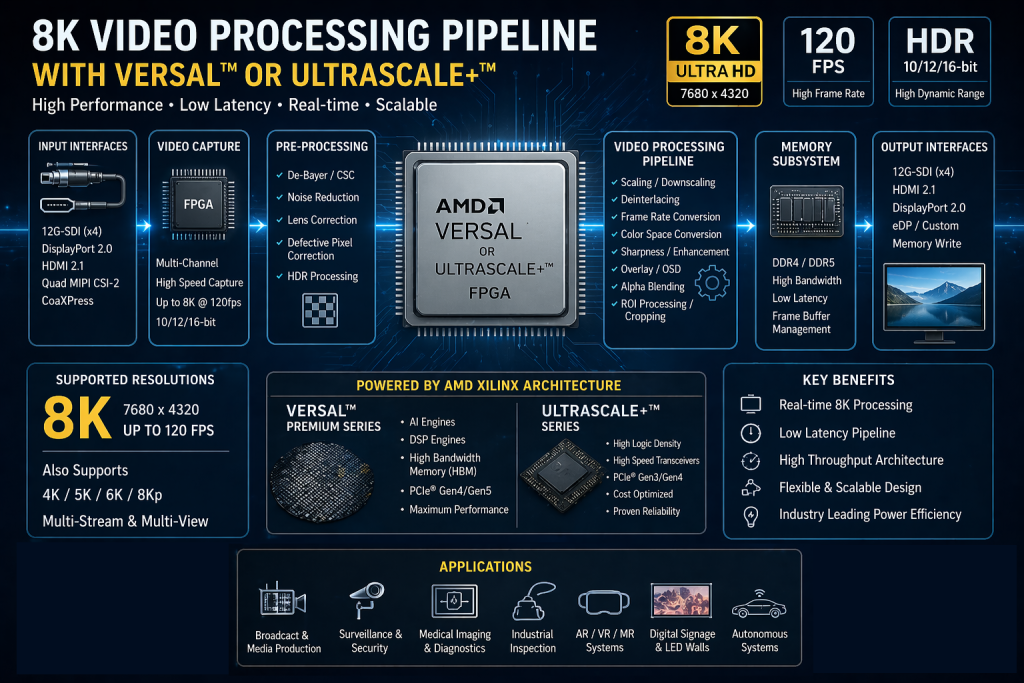
Figure – 8K video processing with AMD-Xilinx Versal or Ultrascale+ FPGA
HDMI 2.1 is designed to transmit 8K60 in 8-, 10- or 12-bit 4:2:0 with no loss of quality. There are also 8K-capable IP subsystems for DisplayPort with AMD-Xilinx FPGA and VIVADO IP Cores. Based on the sensor and processing pipeline throughput, LogicTronix can enable 8K display on both bare-metal and Linux-based platforms.
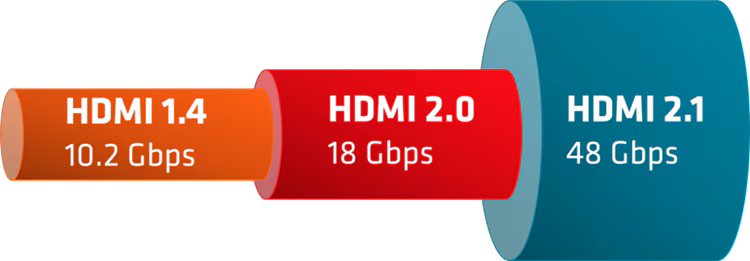
Figure: Bandwidth capabilities of HDMI versions [Reference – AMD-Xilinx]
8-Lane MIPI-Based Designs with Versal and Ultrascale+ FPGAs
For applications requiring high-bandwidth camera interfaces, LogicTronix provides 8-lane MIPI-based FPGA designs built on Ultrascale+ and Versal architectures. These solutions support multi-camera configurations and high data rate transmission, making them suitable for advanced vision systems, autonomous platforms, and industrial imaging. Customers looking for scalable 4+ lane MIPI solutions can benefit from our optimized designs that balance performance, power, and flexibility.
For interfacing image sensors exceeding 40 megapixels or more than 4K resolution, significantly higher data throughput is required, which necessitates the use of an 8-lane MIPI pipeline. Such high-bandwidth designs typically demand support for 16-bit or higher data formats to preserve image quality and dynamic range.
In addition, achieving efficient processing at these data rates requires a pixels-per-clock (PPC) architecture greater than 4, ensuring the pipeline can handle the increased data volume without bottlenecks.
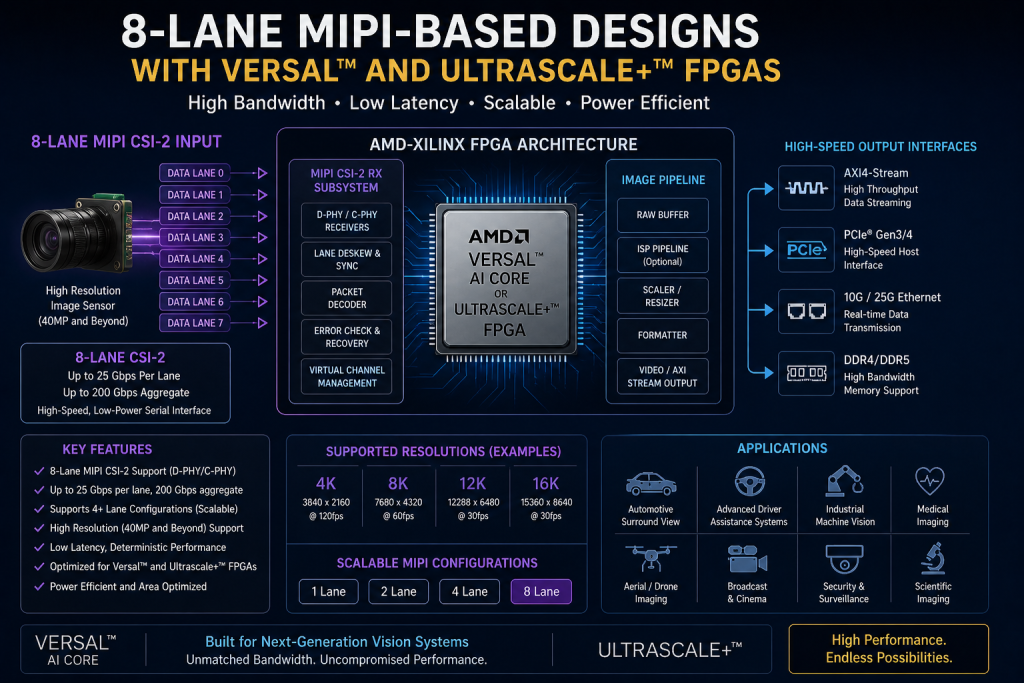
Figure – 8 Lane MIPI based design for high resolution sensors with Ultrascale+ or Versal
Custom CNN and Edge AI RTL Accelerator IP Solution by LogicTronix
LogicTronix is developing high-performance custom CNN accelerator RTL IP tailored for vision-based machine learning workloads on FPGA platforms.
- This accelerator is designed with a focus on low latency, high throughput, and efficient resource utilization, enabling real-time image classification, object detection, and advanced vision analytics directly at the edge.
- By leveraging optimized dataflow architectures and hardware-friendly neural network designs, LogicTronix ensures scalable and power-efficient deployment across AMD-Xilinx FPGA platforms, ranging from low-power Artix series devices to ultra-high-density, high-throughput Versal architectures, enabling optimized solutions for both edge and high-performance computing applications.
In parallel, LogicTronix is expanding its capabilities into LLM acceleration and next-generation Edge AI and Physical AI solutions using MPSoC and Versal platforms.
- This solution target intelligent systems that require on-device processing, reduced cloud dependency, and faster decision-making. With the integration of AI engines, programmable logic, and embedded processors.
- LogicTronix delivers end-to-end acceleration frameworks capable of supporting both vision ML and large model inference for applications in automotive, robotics, autonomous systems, and industrial AI.
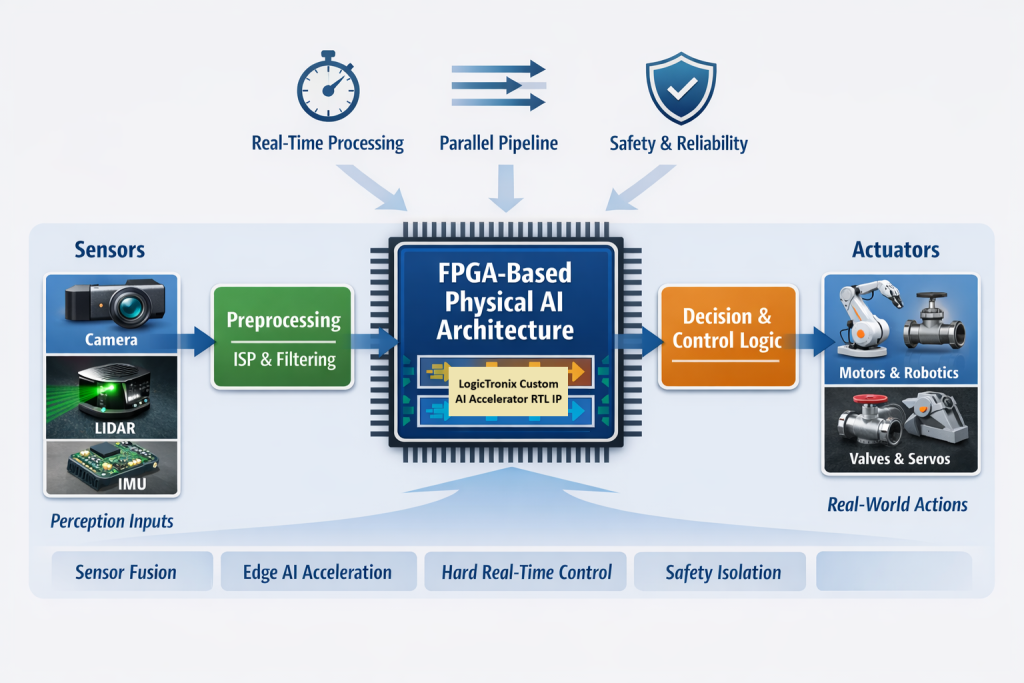
Figure – LogicTronix custom AI Accelerator RTL IP solution with AMD-Xilinx FPGA for Physical AI application
Designing Physical AI and Industrial Systems with AMD Embedded+ Platforms
AMD Embedded+ architecture combines AMD Ryzen™ Embedded processors and Radeon™ graphics with Versal™ adaptive SoCs into a compact, single-board solution. This architecture helps designers reduce system complexity and cost while accelerating time to market, delivering scalable and versatile computing platforms suited for a wide range of real-time applications.
Industrial PCs (IPCs) and other embedded systems built on the Embedded+ architecture benefit from a best-of-both-worlds design. They combine flexible FPGA programmability with efficient data pipelines from sensor to IPC, along with integrated video codecs and AI Engines for machine learning inference. In addition, built-in Radeon graphics support enhanced 4K multimedia capabilities, making these platforms well suited for IPCs, medical displays, and industrial HMIs.
Leveraging the Embedded+ architecture and platform, LogicTronix offers performance-optimized solutions for automotive ADAS sensor fusion solution, medical system design, industrial and Physical AI applications. The FPGA and SoC components enable ultra-low-latency sensor data pipelines and real-time inference, while the x86 processor paired with integrated GPU supports advanced visualization and 3D rendering for rich, interactive user experiences.
A Mini-ITX form factor motherboard from SAPPHIRE Technology, featuring a Ryzen R2314 processor paired with a Versal VE2302 device, delivers a total power consumption as low as 30W. It is also available as the VPR-2616-SYS, a fully pre-configured and packaged solution. More details of Sapphire Embedded+ platform can be found here – https://www.sapphiretech.com/en/embedded-plus-explore
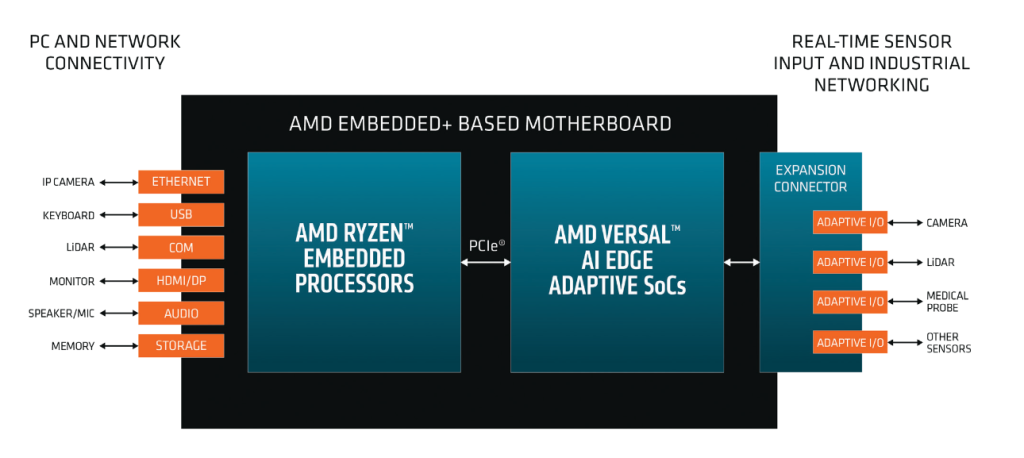
Figure – AMD Embedded+ Architecture – PCB Board connection and I/O flow (Source – AMD)
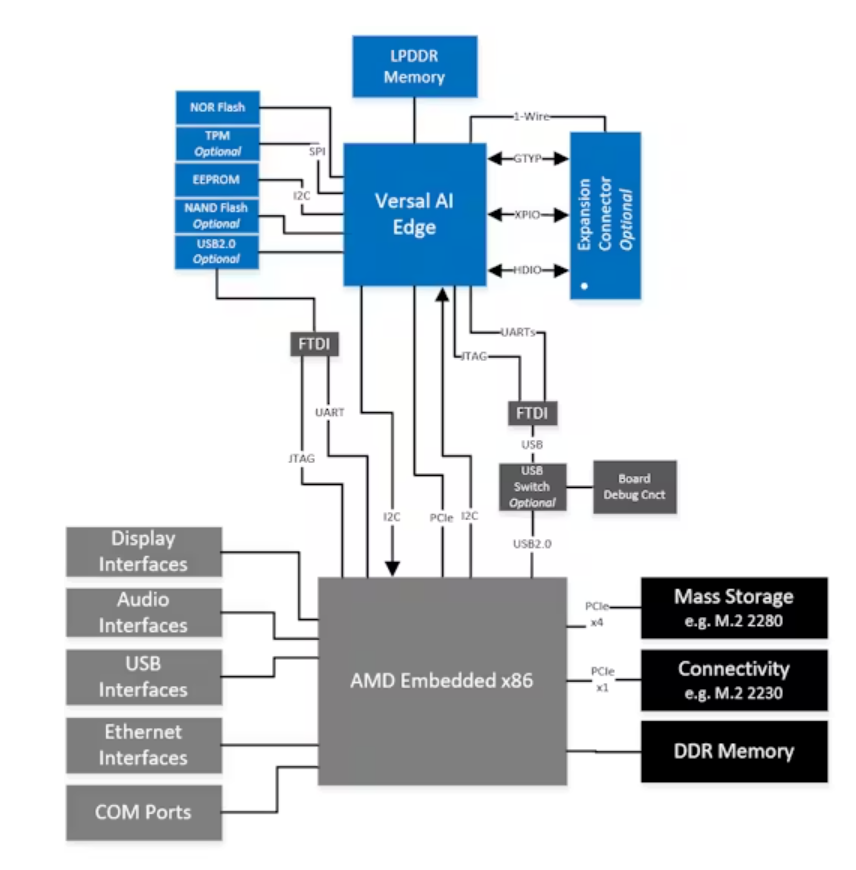
Figure – AMD Embedded+ detail architecture (Source – AMD)
Automotive Driver Monitoring System (DMS) with Neuromorphic Sensors
LogicTronix offers an innovative automotive Driver Monitoring System (DMS) powered by high-speed neuromorphic sensors and efficient FPGA-based processing. Designed for low power consumption and compact form factors, this solution leverages advanced neuromorphic algorithms to deliver real-time driver behavior analysis and safety monitoring. It is ideally suited for modern intelligent vehicles, supporting enhanced safety features and next-generation automotive applications.
Demo of Neuromorphic DMS solution with AMD FPGA: