
LogicTronix has developed advanced 8K and UHD+ video testing pipelines leveraging the latest AMD-Xilinx FPGA technologies, including Versal and Ultrascale+ architectures. These pipelines support ultra-high-resolution video processing, enabling developers to validate and optimize video systems for next-generation broadcasting, surveillance, and AI-based analytics.
Our solutions ensure high throughput, synchronization, and real-time processing capabilities for demanding 8K applications.
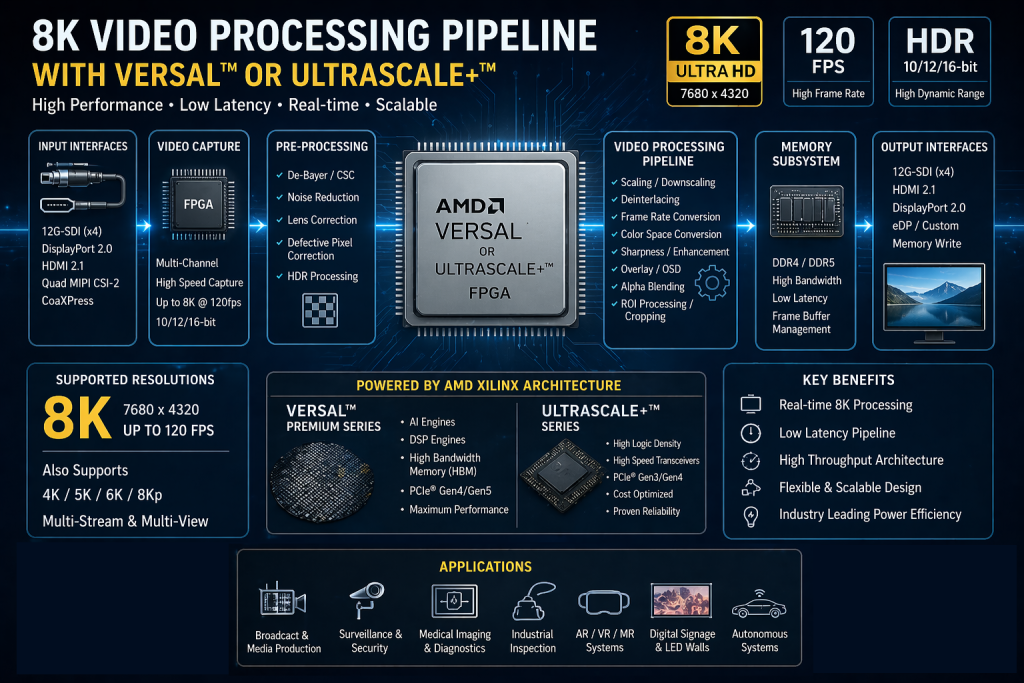
Figure – 8K video processing with AMD-Xilinx Versal or Ultrascale+ FPGA
HDMI 2.1 is designed to transmit 8K@60 in 8-, 10- or 12-bit 4:2:0 with no loss of quality. There are also 8K-capable IP subsystems for DisplayPort with AMD-Xilinx FPGA and VIVADO IP Cores. Based on the sensor and processing pipeline throughput, LogicTronix can enable 8K display on both bare-metal and Linux-based platforms.
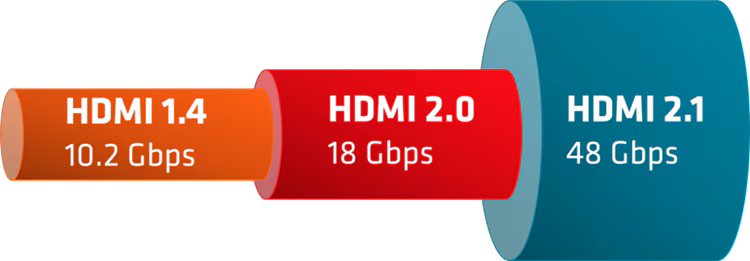
Figure: Bandwidth capabilities of HDMI versions [Reference – AMD-Xilinx]
High-Speed Multi-Interface Video Capture, ISP, Processing, and Output
1. High-Speed Video Input Interfaces
The first stage of an 8K video processing system is the ability to acquire high-bandwidth video from a wide range of cameras, sensors, broadcast equipment, displays, and other video sources.
The FPGA can be designed to support multiple input technologies, depending on the application and selected transceiver/I/O architecture:
- 12G-SDI
- DisplayPort
- HDMI 2.1
- MIPI CSI-2
- CoaXPress
- USB 3.0 / USB 3.x
- Other proprietary or application-specific video interfaces
2. FPGA-Based Multichannel Video Capture
A typical capture pipeline can include:
Interface Receiver → Protocol/Data Extraction → Video Format Conversion → AXI4-Stream → Processing Pipeline
3. FPGA-Based ISP Pipeline
A typical FPGA ISP pipeline can include:
RAW Processing
- Black-level correction
- Defective/dead pixel correction
- Lens shading correction
- Digital gain
- Demosaicing
- White-balance processing
Image Enhancement
- Noise reduction
- HDR processing
- Wide dynamic range processing
- Gamma correction
- Tone mapping
- Color correction
- Edge enhancement
Video Conversion
- RGB/YUV conversion
- Color-space conversion
- Pixel-depth conversion
- Cropping
- Scaling
- Frame-rate conversion
4. High-Performance Multichannel Video Processing
The processing pipeline can include:
- Scaling and downscaling
- Cropping and region-of-interest processing
- Deinterlacing
- Frame-rate conversion
- Color-space conversion
- Sharpening
- Image enhancement
- Alpha blending
- Overlay and OSD
- Multi-stream composition
- Multi-view processing
- Video format conversion
5. 8K and High-Resolution Video Processing
An 8K video stream contains 7680 × 4320 pixels, creating a very large amount of data to capture, process, buffer, and transmit.
At high frame rates and higher pixel depths, the required throughput increases substantially. For example, an 8K pipeline supporting HDR and 10-, 12-, or 16-bit processing can require substantially more internal bandwidth than a conventional 4K 8-bit pipeline.
This is why an 8K FPGA architecture needs to consider the entire data path:
Input Interface → Capture → ISP → Video Processing → Memory → Output
A bottleneck at any one stage can limit the performance of the complete system.
6. Memory and Frame Buffer Management
Frame buffers may be required for:
- Multi-frame buffering
- Video synchronization
- Frame-rate conversion
- Scaling
- Deinterlacing
- Multi-stream composition
- Temporal processing
- Display buffering
- AI/vision preprocessing
7. High-Speed Video Output Interfaces
The output side of the architecture can support interfaces such as:
- 12G-SDI
- DisplayPort
- HDMI 2.1
- MIPI
- CoaXPress
- USB 3.0 / USB 3.x
- Custom video or memory interfaces
8. Versal and UltraScale+ for Video Processing
UltraScale+
UltraScale+ devices provide a mature programmable FPGA architecture for implementing:
- High-speed video capture
- Custom ISP pipelines
- Video processing
- MIPI processing
- SDI processing
- HDMI/DisplayPort interfaces
- Custom video protocols
- Frame buffering
- PCIe and high-speed connectivity
Versal
Versal adds a heterogeneous architecture combining programmable logic with processing systems and, on appropriate device families, AI Engines, DSP resources, integrated multimedia functions, and high-speed connectivity.
This allows a video pipeline to combine:
Programmable Logic + ISP + DSP/AI Engine + Processing System + Memory + High-Speed I/O
9. 8K Video Processing for Vision and AI
Once the incoming video has passed through the ISP, the processed stream can be divided into multiple paths:
Camera → ISP → Video Processing →
- Display
- Recording
- AI/ML inference
- Computer vision
- Image analytics
- Video encoding
- Network transmission
- Storage
For example, an automotive or industrial system could use the ISP output for display while sending another processed stream to an AI accelerator for running the AI/ML Inference and Sensor Fusion.
Building a Custom 8K FPGA Video Processing Pipeline
A high-performance 8K video system is not simply an FPGA connected to an 8K camera. The entire architecture must be designed around bandwidth, parallelism, latency, memory, interface requirements, and processing depth.
LogicTronix can develop customized FPGA video-processing solutions covering:
High-Speed Interface → Multichannel Capture → ISP → Video Processing → Frame Buffer → AI/Vision Processing → High-Speed Output
with support for AMD Versal and UltraScale+ FPGA platforms and application-specific video interfaces.
Whether the requirement is a single high-resolution camera, multiple synchronized video streams, an 8K video-processing system, or a complete camera-to-display/AI pipeline, the architecture can be optimized around the required throughput and latency.